Teaching
I taught undergraduate and graduate biology at San Diego State for four years, and have spent the years since explaining population genetics to audiences who did not come to it through a biology degree. Both are the same problem: finding the version of an idea that fits in someone’s head.
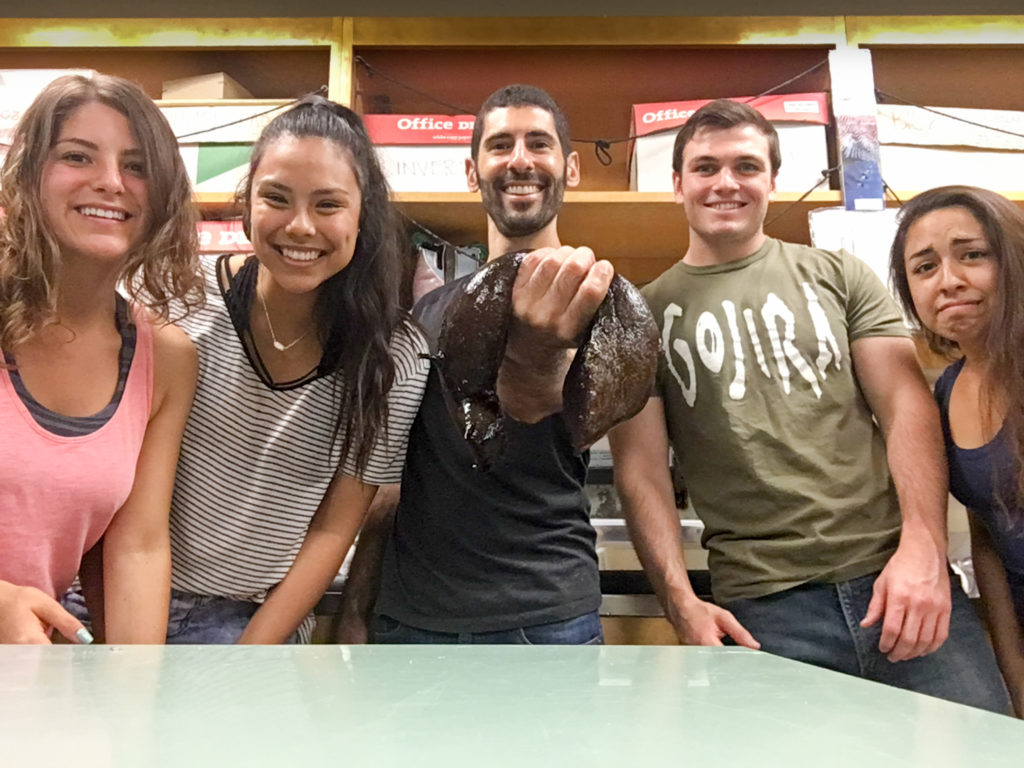 Teaching with Aplysia vaccaria, the California black sea hare. Mixed reactions.
University courses
Biology 352: Genetics and EvolutionTeaching Associate, 2014–2016 · upper division · 5 sectionsTransmission genetics, population genetics, and evolutionary biology. Weekly activity sections built around computer exercises, problem sets, and discussion of primary literature.
Biology 204: Organismal BiologyTeaching Associate, 2017–2018 · lower division · 2 sectionsDiversity and systematics across bacteria, protists, fungi, plants and animals, with laboratory work in observing, identifying, and classifying life and evaluating adaptive significance.
Biology 523: HerpetologyTeaching Associate, 2016–2017 · undergraduate and graduate · 1 sectionEvolution, systematics, distribution, and ecology of the amphibians and reptiles of the world.
Biology 624: Population GeneticsInvited Guest Lecturer, 2016–2017 · graduateGenetic diversity in natural populations, drift, mutation, gene flow, selection, nucleotide variation, and quantitative genetics, with the emphasis on analysing and interpreting real data. I designed the population genomics workshop for this course.
Graduate tutorials
Two runnable walkthroughs written for the Biology 624 population genomics workshop, still online and still working: Analysis of Population Structure: Microsatellites vs. ddRADseq, which compares the power of the two marker types to resolve population structure, and Population Genomics: Identifying Outlier Loci and Predicting Future Adaptation.
Mentoring
Mentored 12 graduate and 6 undergraduate students on projects spanning phylogenetics, landscape genetics, amphibian disease, and field methods. I also chaired the student job search committee for two genomics and quantitative biology faculty searches, and served as president of the SDSU Natural History Club.
Teaching outside the classroom
Most of my teaching now happens at conferences, in webinars, and on video. A three-part series explains myOrigins 3.0 from first principles: overview, methodology, and interpreting your results. Selected talks:
2026 Mitotree: the frontier of mitochondrial DNA researchGenetic Genealogy Research Network, University of Strathclyde · video
2025 Mitotree: the frontier of human phylogenetic research42nd Annual Willi Hennig Society Meeting
2025 Mitotree Discover demo: a year of breakthroughs in maternal lineagesRootsTech International Conference, Salt Lake City
2024 Ten years of evolutionary research on the Yosemite toadTucson Herpetological Society (invited) · video
2023 Big Y: march of the ages15th International Conference on Genetic Genealogy · video
2023 Beethoven’s first DNA testFamilyTreeDNA Town Hall (invited) · video
2022 The Million Mito Project: growing the tree of womankindRootsTech International Conference · video
2022 The tree of mankind age estimatesRootsTech Innovator Session (invited) · video
2021 Everything you wanted to know about mitochondrial DNAGenealogical Forum of Oregon · video
Read my teaching evaluations →
A complete list of talks is in my CV. Papers and reports are on the Publications page.